
Laws of Existence: Understand, Align, and Harness#
This Deepawali we clean the house, light lamps, give gifts, and meet the people we love. These acts follow custom. Custom is one kind of law. It has a place. The day also lets us see a difference that is easy to miss. The difference is between living by laws and living by dharma.
Wisdom is understanding the laws of existence. Skill is aligning our actions with those laws. Success is harnessing their power without unnecessary resistance.
Harness means we use that power in our work.
Different kinds of laws#
None of these laws was given to humans. None was revealed. People paid attention. Outside, they watched nature, society, and the market. Inside, they watched the dance of the mind and its restlessness. The mind keeps moving. Thoughts and desires keep coming. Fear also keeps coming.
Over a long time, wise people discovered some laws, invented some, and drafted some. Drafted means they wrote the rule on purpose. They did this for the well-being of human beings.
| Type | How it came | Examples |
|---|---|---|
| Natural laws | Discovered by watching nature | Gravity, heat, electricity |
| Mathematical laws | Invented by reasoning about number, shape, and chance | Algebra, geometry, probability |
| Legal laws | Drafted by people who govern | Constitution, criminal law, taxation |
| Economic laws | Discovered by watching markets | Supply and demand, diminishing returns |
| Cultural laws | Invented and kept through tradition | Marriage, mourning, celebrations |
| Social laws | Made as shared expectations of how people should behave | Respect, reciprocity, etiquette |
| Moral laws | Discovered by watching harm, care, and the restless mind | Honesty, justice, compassion |
| Religious laws | Drafted by people, then kept as scripture and duty | Commandments, religious duties |
| Organizational laws | Drafted inside institutions | Policies, procedures, responsibilities |
| Personal laws | Drafted by a person for their own life | Habits, commitments, personal principles |
These types can overlap. A moral rule can later become a legal rule. In every case, human beings did the work.
Reciprocity means this: if someone helps you, you help them in return.
A law can do three kinds of work. It can say what happens. A stone falls, even if people make a rule that it should stay in the air. It can say what people should do. People can break that kind of rule. Sometimes they should, when the rule harms human well-being. It can also say what follows from starting rules, as in mathematics. If we change the starting rules, the result can change.
Harnessing a law#
Suppose you want to cross a river. You can fight the current and become tired. Or you can learn the flow, the depth, and the direction, and then reach the other side. You have not left your goal. You have matched your action to the river.
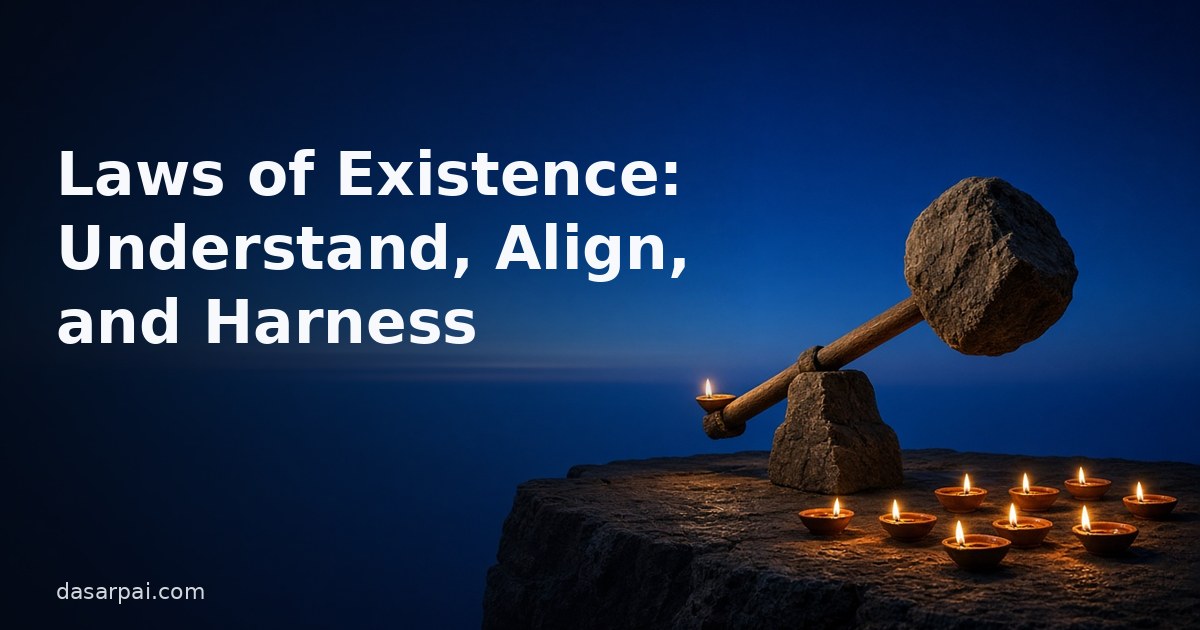
A law works in the same way. It is like a lever. A lever is a simple bar. A small push at the right place moves a heavy weight. Your effort remains yours. The law adds the rest of the power. You are not alone in the work.
If you do not understand the law, even a small work is difficult. You work against the way things already move. You carry the full weight yourself.
This help does not choose your goal. A careful person who understands the law gets more help. A greedy person who understands the law also gets more help. More intelligence makes the help stronger. It does not tell you which goal is right.
Dharma is not one more law#
In Indian thought, dharma means action that holds life together. It includes duty, fairness, and care. Dharma is not one more row in the table. The other laws are below it. We use dharma when a lower law harms people, when two laws conflict, or when our wish and the well-being of others do not match.
This is the difference that is easy to miss. If we treat dharma as one more rule to obey, we are still living by laws. Dharma is the guide we use to judge the laws.
If you follow a law, you get some power. If you refuse an unjust law, you may face loss, punishment, or prison. Both are real. Both are small when we compare them with the power of understanding dharma. A lower law helps one task. Dharma tells us which task deserves that help, and which danger is worth facing.
Science shows the same order. Sometimes a test does not agree with a law of physics. Scientists do not throw away mathematics. They ask whether some condition was missed. Friction, heat, or a force they did not measure can make a true pattern look false. Our understanding of the physics is not yet complete. Mathematics still guides the search. In the same way, when a written law or a custom does not serve well-being, we keep dharma as the guide. We ask which condition we missed. Often it is this: who gains, who pays, and what harm comes later.
When we live by laws#
We do what the rule says. We avoid punishment. We may also find a gap and take a gain, while other people pay the cost. The action can remain legal. The work can succeed. We may call this a good life.
On Deepawali, living only by laws looks like this. We light the lamp because the custom says so. We give the gift because people expect it. The custom can be followed correctly. Someone can still be harmed.
Three things hide this. A sharp mind builds a better reason. An old list of right and wrong makes our own group look moral. Greed keeps the desire and changes the name to duty. The person says, “I earned this.” Or, “My people come first.” Or, “The rule allows it.”
When we live by dharma#
We do not throw the laws away. We still harness them. Dharma decides the use.
Sometimes dharma says: follow this law. Sometimes it says: resist this law, even at a personal cost. A law that refuses to treat a group of people as full human beings is such a law. Sometimes dharma says: do not use the gap, even when the use is legal and we would gain from it.
Before we use the lever, we ask three questions.
Would I still call this right if I could not hide it?
Does this hold life together for the people who are affected, or only for my group?
If the personal gain is removed, would I still call it duty?
If the answers change, we are living by cleverness, by an old list, or by greed. We are not living by dharma.
What is legal is not always what is moral. Obedience is not dharma. Cleverness is not wisdom.
A word for this Deepawali#
Light the lamp. Meet your people. Follow the good customs of the day. Then remember the larger guide. A law is a small lever. Dharma is the larger one. Living by laws can make one task succeed. Living by dharma asks whether that success is worthy of the life it will shape.
Wisdom is understanding the laws of existence.
Skill is aligning our actions with those laws.
Success is harnessing their power without unnecessary resistance.
Is there anything more important than success in life?
Yes. It is to be a witness. A witness sees success. A witness sees failure. A witness also sees the flow of life around us and within us. To see means we notice what is happening. We do not get lost in the result.
Accept life as this flow. Acceptance does not mean that nothing should change. If, after this seeing, you still feel that something should change, then change it. Do not struggle against the way things already work. Follow the laws. Understand dharma. The laws then add their power to the change, and dharma keeps the change worthy.
Wish you a very happy Deepawali for Year 2026 (Virkam Samvat 2083)
Hari Om Tat Sat
Yours Truly Hari
Hashtags#
#Deepawali #Dharma #LawsOfLife #HumanWellBeing #Wisdom #Diwali #MoralLaws #Justice #Philosophy #Mind
Comments: